Keep Follow-Up Consistent Across the Customer Journey
Respond quickly, maintain consistent contact and give your team clear next actions—without relying on someone remembering to chase every enquiry, quotation, candidate or appointment manually.
Good Opportunities Are Often Lost After the First Response
Most businesses do not deliberately ignore enquiries. Opportunities are usually lost because staff are busy, information is spread across different tools, and nobody has clear ownership of the next action.
Slow responses
Messages arriving during busy periods, evenings or weekends may sit unanswered until the potential customer has contacted someone else. Staff also lose time typing repetitive acknowledgements and reminders the system could handle.
Quotes and proposals going cold
A quote may be sent once and then forgotten because the next follow-up depends entirely on someone remembering. Older enquiries, candidates and prospects are similarly overlooked inside spreadsheets and databases.
Inconsistent staff follow-up
Some opportunities receive excellent attention while others receive little or none, making performance difficult to manage and impossible to standardise across the team.
Poor pipeline visibility
It is difficult to see who has been contacted, who has replied, which opportunities need attention and where prospects are being lost across the journey.
Follow-Up Triggered by What Actually Happens
LeadAI does not force every business into one generic sequence. Timing, channels, messages and exit rules are designed around the client's genuine process.
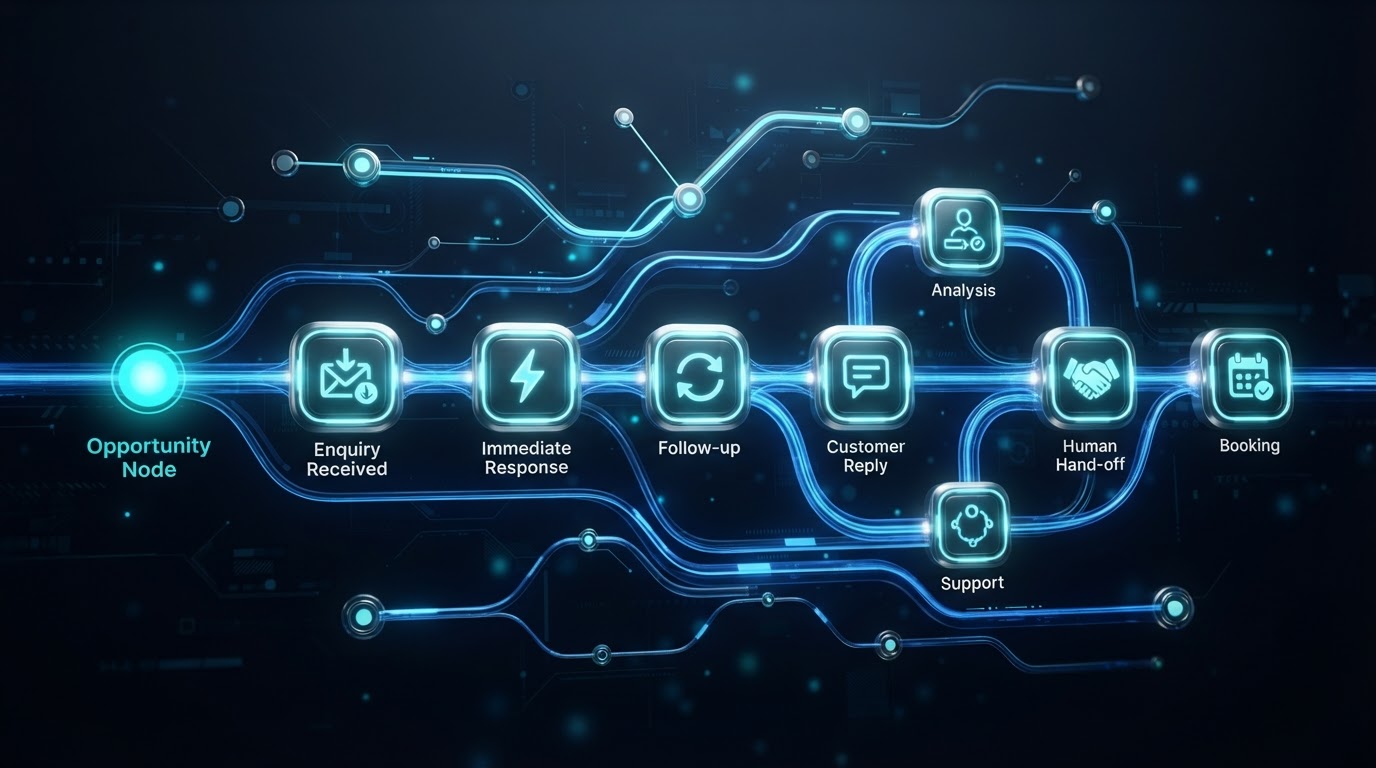
1. Opportunity captured
An enquiry, missed call, form submission, appointment request or new database contact enters the system.
2. Immediate acknowledgement
The person receives an appropriate SMS or email confirming that their enquiry has been received and explaining what happens next.
3. CRM record and ownership
The contact is added or updated inside the CRM, placed into the correct pipeline stage and assigned to the appropriate team member.
4. Relevant follow-up begins
Messages and internal tasks are triggered according to the opportunity type, status and agreed communication schedule.
5. Behaviour changes the journey
When someone replies, books, declines or moves to another pipeline stage, the system updates the journey and stops irrelevant messages.
6. Human action is prioritised
Staff receive notifications and tasks when personal contact, judgement or a commercial conversation is required.
Timing is configured around the client's sales cycle, urgency, audience and communication permissions. There is no universal fixed schedule—every sequence is set to match how the business genuinely works.
One System—Different Commercial Journeys
New enquiry follow-up
- Confirm the enquiry immediately and gather missing information
- Notify the correct person and prompt the prospect to book or respond
- Create follow-up tasks when human input is required
- Stop the sequence once the next action is completed
Quotation or proposal follow-up
- Record when a quotation is issued and schedule appropriate check-ins
- Give staff visibility of open quotations
- Identify accepted, declined and unresponsive opportunities
- Prevent irrelevant reminders after a decision is made
Database re-engagement
- Segment appropriate existing contacts
- Send controlled, relevant communications
- Record replies and move responsive contacts into an active pipeline
- Exclude contacts without an appropriate lawful communication basis
Appointment and booking follow-up
- Send confirmations, reminders and booking information
- Reduce unnecessary manual administration
- Trigger rescheduling or staff tasks where appropriate
- Begin the correct post-appointment journey
Adapted to the Process—not Just the Industry
Recruitment agencies
- Candidate application acknowledgement and missing-information requests
- Interview and registration reminders
- Dormant candidate re-engagement
- Client and vacancy follow-up with consultant tasks
LeadAI can complement the agency's existing process and is not presented as a replacement for a specialist ATS.
Trades and local services
- New quotation requests and missed-call responses
- Site-visit scheduling
- Open-quotation follow-up and job-status communication
- Review requests after completion
Other enquiry-led businesses
- Consultation requests and appointment reminders
- Proposal follow-up and lead nurturing
- Existing-contact re-engagement
- Internal task creation and pipeline visibility
Automate the Repetition—Keep People in Control
Automation should improve consistency without creating robotic or inappropriate communication. LeadAI designs clear hand-off points so staff remain responsible for conversations requiring judgement, sensitivity, negotiation or specialist knowledge.
Messages use the client's approved tone and factual information
Replies, bookings and status changes can stop or redirect automation
Staff are notified when human action is required
Journeys are tested before launch and refined using real operational feedback
Implementation & Responsible Communication
Responsible follow-up depends on clear permissions, accurate sender details and sensible message frequency. The client must confirm the appropriate communication basis and permissions for each audience and message type—LeadAI does not provide legal advice or independently determine the client's lawful basis.
What the Implementation Can Include
The final scope depends on the client's existing software, contact volumes, communication channels and operational requirements.
Relevant, Controlled and Permission-Aware
Confirmed communication basis
The client confirms the appropriate communication basis and permissions for each audience and message type.
Clear sender identity
Messages use correct sender identity and branded, recognisable details.
Opt-out handling
Unsubscribes and opt-outs are respected and reflected across the system.
Frequency and suppression
Sequences are paced appropriately and completed or irrelevant journeys are stopped.
Follow-Up Is Strongest When the Entire Journey Is Connected
Automated follow-up is not sold as an isolated message sequence. It connects to the wider LeadAI system so communication reflects what has happened before and what needs to happen next.
Where Does Your Follow-Up Currently Break Down?
Book a Growth System Audit to map your current response and follow-up process, identify where opportunities are being lost, and determine whether a connected system would create measurable value.