Bring Enquiries, Follow-Up and Next Actions Into One Clear Process
LeadAI designs connected systems around businesses with meaningful enquiry, booking, proposal or customer-management processes—helping teams organise information, ownership and appropriate follow-up.
The Industry Matters—But the Process Matters More
LeadAI may be relevant when a business has a repeatable process, a commercially meaningful outcome and a clear operational problem worth improving.
Repeatable opportunities
Enquiries, referrals, consultation requests, quotations or commercial opportunities follow a broadly recognisable journey.
Meaningful value
The value of progressing an appropriate opportunity justifies investing in a better process.
Multiple touchpoints
Customers or commercial contacts may interact through telephone calls, forms, email, appointments or other approved channels.
Ownership matters
The organisation needs to know who is responsible and what should happen next.
Follow-up matters
Opportunities, proposals, appointments or existing relationships may require structured future actions.
Outcomes can be recorded
The business can define useful stages and record whether an opportunity progressed, paused, completed or closed.
A business does not need every characteristic, but there must be a specific operational or commercial problem worth solving.
Examples of Businesses With Suitable Process Patterns
These are examples, not claims of existing clients or proven sector specialisms.
Professional and advisory services
Businesses managing consultations, enquiries, proposals, appointments and ongoing client communication.
Property and facilities businesses
Organisations handling property enquiries, inspections, service requests, contractors, quotations or client updates.
Transport, logistics and workforce businesses
Companies coordinating commercial enquiries, workforce information, availability, assignments, documentation or operational follow-up.
B2B contract and supply businesses
Businesses managing incoming requirements, quotations, proposals, account follow-up and longer commercial buying journeys.
Appointment-led organisations
Businesses where enquiries need to become consultations, assessments, bookings or another clearly defined next step.
Fit depends on the real process, not the sector label
These examples do not mean every business in the category is automatically suitable. Fit depends on the process, value, volume, team and technical environment.
The Problem Is Often Between the Tools
Scattered information
Relevant details may sit across inboxes, spreadsheets, telephone notes, forms and separate platforms.
Unclear ownership
A record may exist without an obvious person responsible for progressing it.
Incomplete initial details
Teams may repeatedly request routine information that could have been captured earlier.
Follow-up depends on memory
Proposals, appointments, open enquiries or account actions may rely on individuals remembering the next step.
Outcomes are not recorded consistently
The organisation may struggle to see which opportunities progressed, paused, completed or closed.
Each gap makes the next decision harder to make
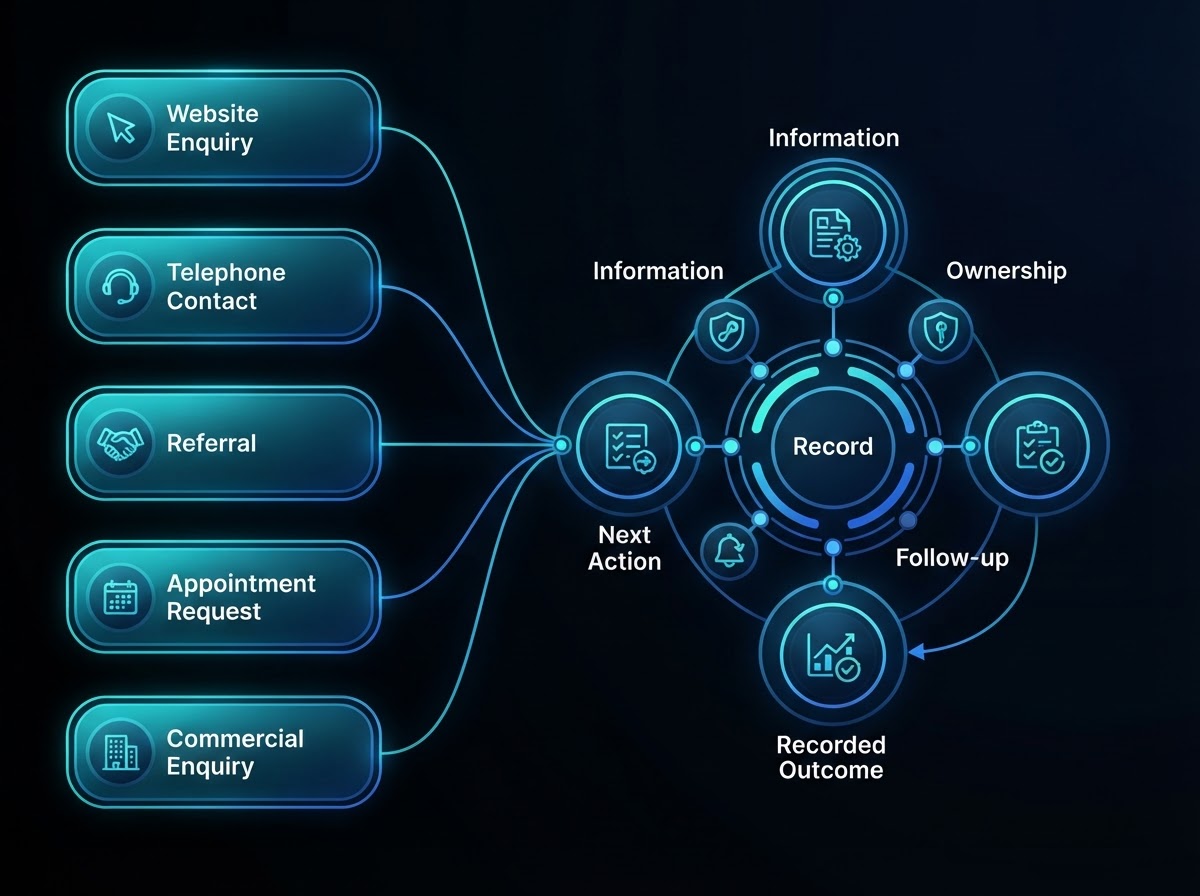
Build Around the Real Route to an Outcome
One visible record from first contact to recorded outcome
- Website enquiry
- Telephone contact
- Referral
- Appointment request
- Existing database contact
- Relevant information
- Qualification questions
- Requirements
- Location or availability where appropriate
- Documents where required and approved
- Ownership
- Internal notification
- Booking
- Proposal or quotation
- Tasks and follow-up
- Current stage
- Next action
- Source information
- Progressed, paused or closed outcome
- Appropriate ongoing communication
Not every implementation uses every module. The agreed journey depends on the business's terminology, responsibilities, existing systems and technical constraints.
Focused Systems Before Large Transformations
Enquiry capture and qualification
Collect relevant information through structured pages and forms.
Pipeline and ownership
Create visible stages, responsible users and clear next actions.
Booking and reminders
Connect appropriate appointment options, confirmations and reminders.
Proposal or quotation follow-up
Support an agreed follow-up process around open commercial opportunities.
Database reactivation
Review, segment and appropriately contact suitable existing records where there is a lawful and commercially sensible basis.
Internal routing and notifications
Direct relevant information or tasks towards the appropriate person or team.
The first implementation should target a specific, measurable bottleneck. Broader systems should only be added when the initial scope is understood and operationally justified.
Do Not Replace Useful Systems Without a Reason
LeadAI first reviews the platforms already used by the business and establishes which system should remain the source of truth. Some processes may be configured inside an existing platform. Others may use connected tools or require a documented manual hand-off. Integrations depend on available APIs, permissions, data quality, technical feasibility and the scope agreed during discovery.
Connected where technically appropriate to:
Not Every Problem Needs a Connected System
There is no defined or repeatable process
The commercial or operational value is too low to justify implementation
The organisation cannot assign ownership internally
Essential systems cannot be connected and no practical hand-off exists
The requirement is primarily for specialist bespoke software beyond LeadAI's agreed delivery capability
If the problem cannot be clearly scoped, responsibly implemented and commercially justified, LeadAI should not recommend unnecessary complexity.
What a Business Systems Engagement Can Include
- Current-process mapping
- Enquiry and opportunity sources
- Team roles and ownership
- Existing software review
- Data and communication requirements
- Bottleneck identification
- Technical feasibility
- Suitable measurement criteria
- Agreed pages and forms
- Pipeline or workflow stages
- Tasks, routing and notifications
- Approved communications
- Calendar or platform connections
- Source tracking where available
- End-to-end testing
- Team handover and refinement
Final scope depends on the process, number of users, contact volume, existing systems, integrations, data condition, messaging requirements and support burden.
Technology Supports the Process—People Remain Responsible
Human decision-makers remain responsible for commercial, professional and operational judgement
Sensitive, unusual or high-risk situations require appropriate human handling
Only relevant information should be collected and retained
Communication permissions, legal duties and sector-specific obligations remain client responsibilities
LeadAI provides operational implementation. It does not provide legal, financial, regulatory, medical, employment or sector-specific professional advice.
Which Part of Your Process Needs More Clarity?
Book a Business Systems Audit to map the current journey, identify the most important bottleneck and determine whether a focused connected system is commercially and technically appropriate.