A Better System for Managing Candidates, Clients and Vacancies
Connect candidate enquiries, vacancy requirements, consultant pipelines and appropriate follow-up around the agency's existing process—reducing fragmented administration and making next actions easier to see.
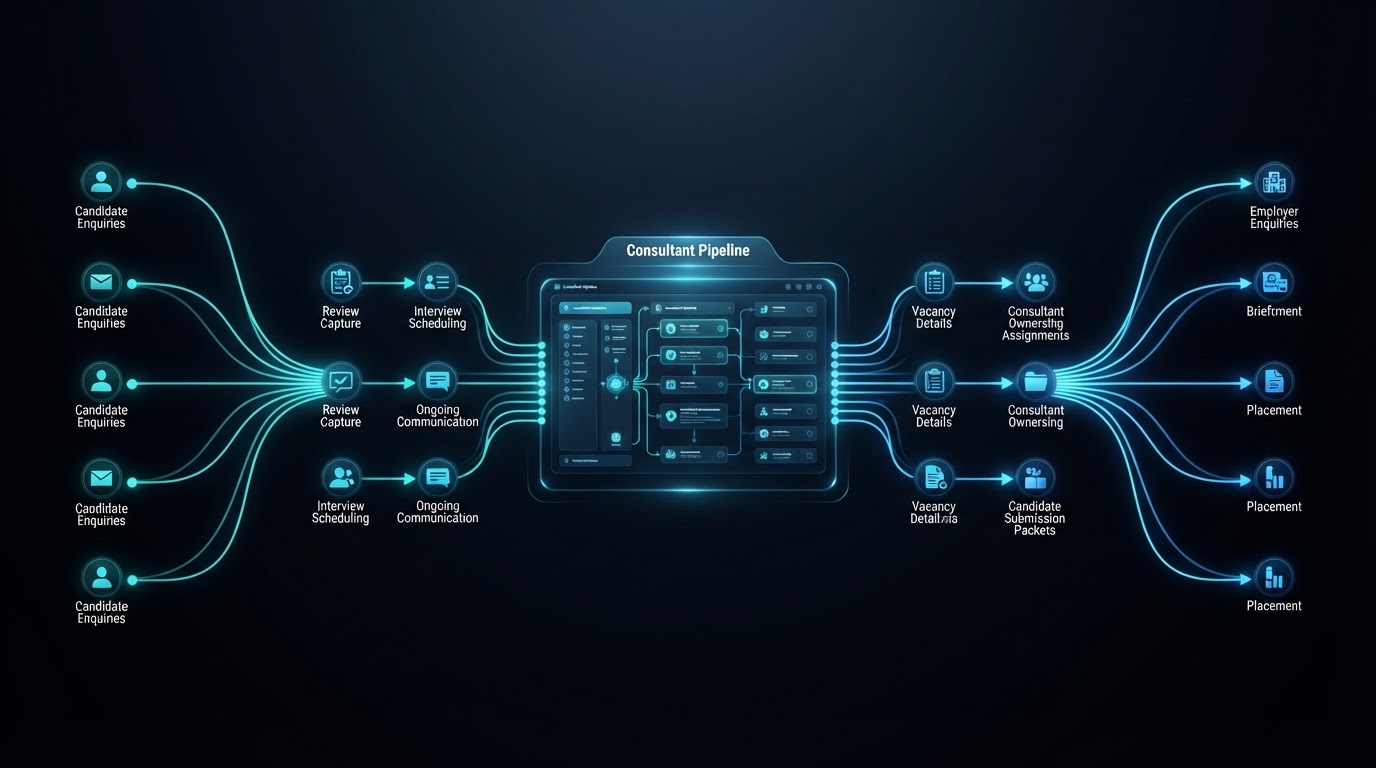
Candidate Delivery and Client Growth Need Connected Processes
Candidate and client journeys are different, but consultants need clear records, ownership and next actions across both.
- Candidate enquiries from websites, campaigns and configured sources
- Structured information and document collection
- Registration or consultation booking where appropriate
- Consultant ownership and next actions
- Relevant candidate communication
- Dormant-candidate re-engagement where appropriate
- Employer and hiring-manager enquiries
- Structured vacancy or requirement information
- Consultant ownership
- Business-development and proposal follow-up
- Vacancy progress visibility
- Post-placement or account-management tasks
Growth Is Harder When Consultants Are Rebuilding the Process Manually
Fragmented enquiry sources
Applications, emails, forms, telephone conversations and referrals may require manual transfer between systems.
Underused existing relationships
Appropriate previous candidates, prospects or client contacts may remain dormant without a reviewed re-engagement process.
Missing initial information
Consultants spend time gathering routine details that could have been requested earlier.
Unclear ownership and next actions
Candidate, vacancy and client records may lack an obvious responsible consultant or follow-up task.
Inconsistent communication
Acknowledgements, interview reminders, vacancy updates and commercial follow-up depend too heavily on individual memory.
A Clearer Candidate Journey Without Removing Consultant Judgement
- 1
Candidate interest captured
An application, registration enquiry or configured campaign response enters the agreed process.
- 2
Relevant information requested
Forms or communications gather approved information such as role interest, location, availability, experience and documents where appropriate.
- 3
Record and ownership established
The candidate is created or updated in the appropriate connected system and directed towards the relevant consultant or team.
- 4
Human review and next action
A consultant reviews the information and decides whether to contact, register, interview, nurture or take another appropriate action.
- 5
Communication continues
Configured acknowledgements, reminders, appointment information or consultant tasks support the agreed journey.
- 6
Outcome remains visible
Relevant status and next-action information is recorded where the connected platforms allow it.
Give Employer Opportunities the Same Operational Discipline
Employer enquiry
Capture the organisation, contact, requirement and source.
Vacancy or requirement brief
Gather agreed role, location, timescale and hiring information.
Consultant ownership
Assign the commercial relationship and create a clear next action.
Progress and communication
Track consultations, proposals, vacancy discussions and agreed follow-up.
Recorded outcome
Record whether the opportunity progresses, pauses, closes or requires future contact.
A client enquiry should not disappear into a consultant's inbox simply because the agency is busy delivering candidates.
LeadAI does not supply employer leads automatically. These touchpoints organise enquiries the agency already receives.
Designed Around the Existing Recruitment Stack
The source of truth for recruitment records
LeadAI connects around it—not over it
LeadAI is not presented as a replacement for a specialist ATS. We first establish what the agency already uses, which system should remain the source of truth, and whether the required connections are technically available.
Some workflows may operate inside the existing platform, some through connected systems, and some may require manual hand-offs. Integrations are confirmed during technical discovery rather than assumed.
Built Around the Bottleneck That Matters Most
An agency may need one focused workflow rather than every module at once. Scope should begin with the most expensive or disruptive bottleneck.
Candidate capture and registration
Structured landing pages, forms, document collection, booking and consultant notification.
Client and vacancy intake
Employer enquiry capture, structured requirement forms, ownership and commercial follow-up.
Consultant pipeline visibility
Candidate, vacancy or business-development stages with clearer tasks and next actions.
Responsible database reactivation
Reviewed segmentation and appropriate re-engagement of suitable candidate or client contacts.
What Implementation Can Include
- Candidate and client process mapping
- Existing ATS and software review
- Bottleneck and ownership identification
- Data and communication requirements
- Integration feasibility
- Success measures
- Agreed forms and pipelines
- Routing, tasks and notifications
- Approved communications
- Calendar or platform connections
- End-to-end testing
- Team handover and refinement
Final scope depends on the agency's team structure, contact volume, ATS, available integrations, data condition and compliance requirements.
Automation Supports the Consultant—it Does Not Replace Professional Judgement
Humans remain responsible for candidate and hiring decisions
Only relevant information should be collected
Sensitive and exceptional situations require human handling
Communication permissions, data retention and sector obligations remain client responsibilities
LeadAI provides operational implementation, not employment-law, data-protection or regulatory advice.
Where Is Your Recruitment Process Losing Time or Visibility?
Book a Recruitment Systems Audit to map your candidate, client or vacancy journey and identify the first workflow worth improving.